Solo, Class or Club: Three Ways to Learn a Craft
Compare learning a craft alone, in a class or through a club to find the pace, feedback and social rhythm that suit your available time.
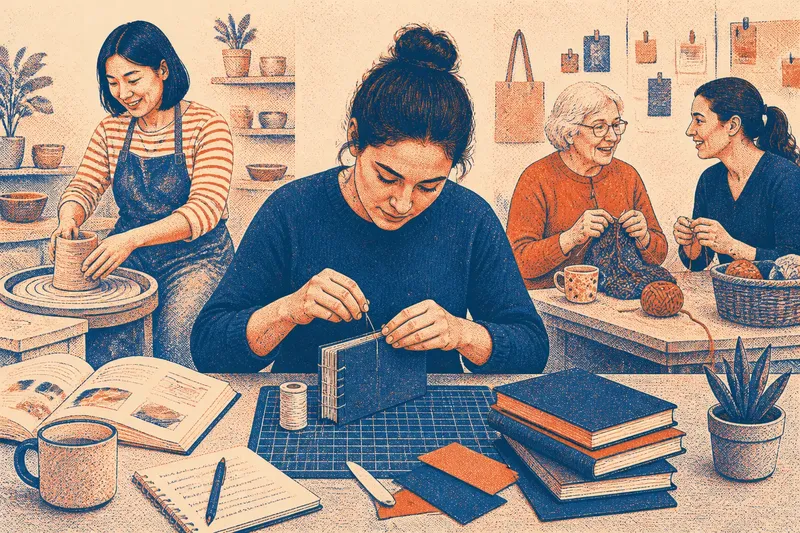
You have a ball of wool, a borrowed pair of knitting needles and a free evening. A video pauses mid-row, the written pattern uses a term you do not know, and nobody is there to say whether the loop is meant to look like that. Learning a craft alone, in a class or through a club changes what happens next: the pace, the feedback and the reason you return.
What do you want from learning a craft?
Before choosing a setting, name the immediate aim. You might want to make one useful object, learn a technique, enjoy an absorbing hour or meet people who share an interest. Those aims overlap, but they do not ask the same thing of a teaching format.
Write down a small, visible result: a straight seam, a glazed tile, a basic chord progression or a simple basket. Then consider what usually stalls you. If you are comfortable finding explanations and correcting small errors, working alone may be enough. If you need someone to spot what your hands are doing, instruction in person may save frustration. If you tend to lose interest without a regular appointment, a group can lend the activity a social rhythm.
Also be honest about the kind of company you enjoy. A room full of beginners can be encouraging, but it is still company. A quiet solo session is not a lesser version of a craft; it is a different arrangement of attention.
Can you learn the basics alone?
Self-directed learning suits a person who likes to pause, repeat and follow a question wherever it leads. Books, printed patterns, library resources and carefully chosen video lessons let you work at your own speed. You can revisit a difficult section without holding up a table of strangers or waiting for a teacher to reach your seat.
Its weak point is diagnosis. A tutorial may demonstrate a hand position, but it cannot see that your grip is too tight or that you have misread a symbol. Look for resources that show the work from more than one angle and explain common errors. A beginner’s sewing book with clear diagrams, for example, may be more useful than a polished montage that omits the awkward middle.
Keep the first project modest and use inexpensive materials where appropriate. Make a sample square before cutting cloth for a garment; practise a few brush marks on scrap paper before starting a finished picture. A sample is like a rough draft: it gives mistakes somewhere harmless to happen.
Set a stopping point for each session, such as finishing one seam or trying one new stitch. If you meet a problem, note the exact question and what you have already tried. That makes the next search more focused and gives you a record of how the difficulty changed.
When is a short class the better choice?
A class is useful when a technique is difficult to understand from a page or screen, or when you want a guided introduction before buying more equipment. A tutor can demonstrate how a tool sits in the hand, notice a repeated error and answer a question while the materials are in front of you. The class also places a boundary around the learning session: you arrive, work, and leave without needing to invent a timetable.
That structure has limits. The group moves at a shared pace, so one lesson may feel hurried to a cautious learner and slow to someone who has already practised. A short class may also teach a single project rather than a transferable skill. Before booking, check what the session covers, what materials are supplied, how much individual guidance is available and whether beginners are expected to know anything beforehand.
Choose a class whose stated outcome matches your aim. If you want to understand wheel-thrown pottery, a one-off session devoted to hand-building may still be enjoyable, but it answers a different question. If you are uncertain, ask the organiser what a learner should be able to do by the end and what follow-on practice is available.
What does a craft club offer that a class cannot?
A club usually offers continuity and company rather than a carefully sequenced lesson. Members may bring separate projects, exchange suggestions and share tools or materials. Some groups have experienced makers who are happy to explain a technique; others are primarily social and expect members to arrive with their own plans.
That distinction matters. A club can provide a reason to keep making, because the next meeting is already on the calendar and someone may ask how the project is going. But it may not provide close instruction. A friendly room is not automatically a teaching service, and a skilled member may not want to become an unpaid tutor every evening.
Ask whether visitors can attend, what members tend to make, whether beginners are welcome and how the meeting is organised. Notice the practical atmosphere when you visit: do people explain materials to newcomers, or settle quickly into work with little conversation? Neither arrangement is wrong; one may simply suit you better.
How do you choose between solo, class or club?
Compare the three settings against the actual obstacle you expect to meet, not against an ideal version of yourself. Say you want to learn basic bookbinding, have one free evening a week and tend to abandon projects when a tool behaves unexpectedly. A short beginner class could help with the first demonstrations; after that, solo practice would allow a flexible pace. If the class reveals that regular company keeps the interest alive, you could then look for a local book-arts group. The sequence is a possibility, not a rule.
- Choose solo learning if you value flexible timing, can find reliable explanations and are willing to troubleshoot.
- Choose a class if you need a demonstration, direct correction or a defined introduction to unfamiliar tools.
- Choose a club if regular company and shared enthusiasm matter more than a formal lesson plan.
- Combine settings if you want a demonstration first and independent practice afterwards.
- Change course if the format repeatedly leaves you stuck, rushed or unable to make time for the craft.
Practical details belong in the decision too. Consider travel, meeting times, the amount of equipment you must bring and whether you prefer a quiet workspace. A nearby class that fits your week may be more useful than a celebrated course that turns each visit into a logistical project.
Which questions should you ask before committing?
How much feedback will I get in a class?
Ask whether the tutor circulates and whether each learner works on the same task. A demonstration with little individual attention may suit a simple introduction, but it is less helpful if you expect detailed correction.
Can I join a club as a complete beginner?
Ask the organiser what newcomers usually bring and whether someone can explain the group’s routine. The answer will clarify whether the club welcomes learners or mainly gathers people who already work independently.
What should I try first if I cannot decide?
Begin with the smallest commitment that addresses your main uncertainty: a free tutorial, a single introductory session or a visitor evening. Afterward, note whether you wanted more privacy, more instruction or more company.
How do I know when to change learning formats?
Look for a recurring mismatch rather than one difficult evening. If you repeatedly need feedback that solo materials cannot supply, seek a teacher; if a class pace keeps interrupting your work, practise independently between sessions.
How can you make the choice without overcommitting?
Give the chosen format enough time to reveal its ordinary character, while keeping the project small enough to abandon without ceremony. For solo learning, make a sample and set a manageable session goal. For a class, arrive with one or two specific questions. For a club, attend as a visitor if possible and watch how members share space and advice.
After a few sessions, ask what is actually helping. You may be progressing slowly but enjoying the work, or making quick gains while dreading the next meeting. Either answer matters. The right way to learn a craft is not necessarily the one that produces the neatest object soonest; it is the one whose pace, feedback and social demands let you return willingly. Start with a format that answers your present need, then change it when that need changes.