The Collection That Stops Being Fun
A collection need not be complete to feel satisfying. Set personal rules for choosing, displaying and pausing objects, so the hobby stays yours.
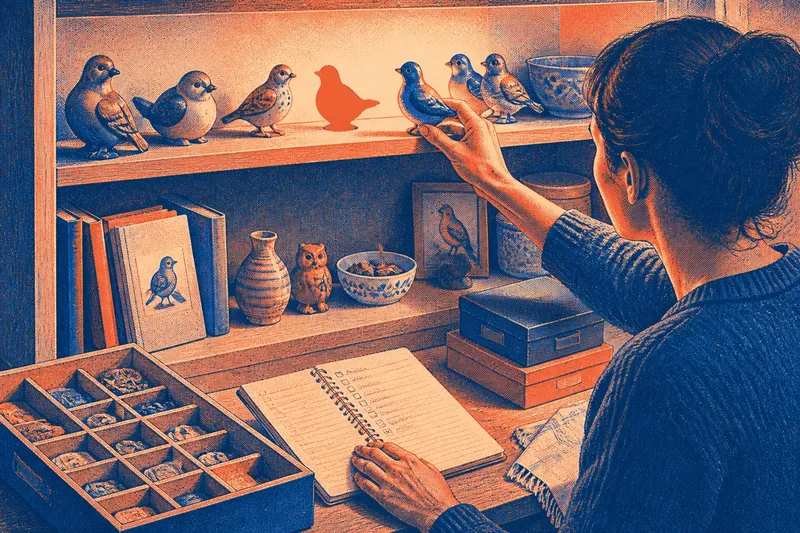
A collector clears a space on the shelf, turns a small ceramic bird to face the light, then notices the gap beside it. The missing bird is already on a list. The shelf has begun to feel less like a pleasure and more like an appointment. A collection can stop being fun when completeness becomes its only measure, and collecting starts to feel lighter when the collector decides what belongs and why.
What makes a collection feel complete?
Completeness sounds like a simple aim, but it depends on who is defining the set. A manufacturer may issue a numbered series. A publisher may release a run of covers. A collector may decide that all the blue ones belong together, or that a collection is complete when every object has a story worth remembering.
Those definitions do not carry equal obligations. A published series creates a visible finish line, but it cannot decide whether the chase still suits the person collecting. The last item may be scarce, expensive, difficult to store or simply less appealing than the objects already owned. None of that makes the existing collection defective.
It helps to distinguish a bounded set from an open-ended subject. A set of a particular maker’s enamel pins may have a known list. “Interesting enamel pins” has no natural end. Open-ended collections can be satisfying, but they need a personal boundary, or the subject can expand to fill every shelf and spare thought.
Completeness is therefore a choice of definition, not a duty owed to a series. A collection can be complete by the collector’s own standard while leaving obvious gaps in a catalogue. The catalogue records what was issued; it does not issue instructions.
Which personal rule should guide a collection?
A useful rule explains why one object belongs and another does not. It should be clear enough to use while browsing, but not so rigid that every exception requires a hearing. Think of it as a frame around a picture: it gives the contents a shape without becoming the subject itself.
Possible rules include:
- Choose by subject: collect only birds, ferry tickets, or objects connected with a particular pastime.
- Choose by material: keep items made from glass, wood, paper or another material you enjoy handling.
- Choose by place: gather objects from local markets, seaside towns or a route you often travel.
- Choose by use: collect tools or games that can still be brought out and used, rather than kept only as display pieces.
- Choose by available space: let one cabinet, drawer or wall determine the collection’s practical limit.
- Choose by story: acquire an object only when you can say what drew you to it, without needing an elaborate justification.
Say you collect ceramic birds and the cabinet has no room for another large figure. You decide that new additions must be small enough to fit on one narrow shelf, and that you may replace an item only if the new bird is more pleasing to you. The likely result is an easier browsing decision: a striking but oversized piece can be admired and left behind, while the shelf remains legible.
That rule is not a moral test. It is a tool for making choices less automatic. If it stops serving you, change it deliberately rather than allowing a retailer’s catalogue or someone else’s checklist to make the decision by default.
How can display change the way you collect?
Display is not merely what happens after collecting. It shapes what is worth keeping, because an object hidden in a box has a different place in daily life from one you can see and handle. A display also makes the collection’s limits visible. One shelf invites selection; an unlabelled stack tends to invite accumulation.
Group objects by a principle that helps you notice them: colour, maker, place, material or a shared use. Leave enough space to see the differences. A row of old board-game counters arranged by colour may look more deliberate than a larger heap, while a few labels can preserve where a ticket or postcard came from. Labels need not turn a hobby into a museum; a place name and a brief note may be enough.
Consider how light, dust and handling affect the objects. Paper ephemera may fade in direct sun; delicate materials can be damaged by frequent movement. For valuable, fragile or unusual pieces, the maker’s care guidance or a conservator can help with appropriate display and storage. For ordinary objects, a clean, stable shelf and a habit of checking their condition may be all that is needed.
A display can also make room for change. Rotate a few objects from storage when you want to see them again, or reserve a section for recent finds. This is not a requirement to keep every item on view. It is a way to learn which objects you genuinely enjoy revisiting and which have become a record of past decisions.
What if you have already collected too much?
Begin by noticing the difference between an object you enjoy and one you keep because it completes a sequence. That distinction may be obvious, or it may take time. There is no need to clear a shelf in one dramatic afternoon, especially if the objects carry family meaning or practical value.
Try sorting into a few temporary groups: display, store, reconsider and pass on. The groups should describe your present relationship with each object, not pronounce it good or bad. A box marked “reconsider” is useful precisely because it does not force an immediate verdict.
Before passing anything on, check whether it belongs to someone else, has a family story attached, or needs particular care. Options can include offering it to another collector, donating it where it will be useful, or selling it if that is appropriate. The right route depends on the object and its circumstances; not every item needs to be turned into a transaction.
One small adjustment can clarify the collection without changing its subject. Remove duplicates from the main display, give a group a defined home, or keep only the examples that best show what interests you. The aim is not to make the collection impressive to a visitor. It is to make it easier for you to notice what you like.
How do you decide whether to keep collecting?
Should I finish a series I have started?
Ask whether the remaining pieces still appeal to you, rather than whether the series has a visible final item. If the search itself has become tedious, you can stop with an unfinished set and still keep the parts you enjoy.
Is it sensible to set a space limit?
A shelf, drawer or display case can offer a plain boundary that is easy to see. When it is full, you can pause, rearrange or choose a replacement before adding more.
What should I do with duplicates?
Keep duplicates when they serve a purpose, such as being usable or showing variations worth comparing. Otherwise, offer them to another collector, give them away or store them separately if you are not ready to decide.
Can a collection change its subject?
Yes. An interest in, say, postcards from one town might widen to include local maps, or narrow to cards with a particular kind of illustration. A change in the rule is a normal part of the hobby, not evidence that earlier choices were wasted.
When is collecting enjoyable again?
Enjoyment may return when choosing an object feels like a preference rather than an obligation. That can mean browsing without buying, displaying fewer pieces, or deciding that a collection is finished for now. A pause is not a promise to resume, and it does not erase the pleasure that came before it.
When you next consider an addition, ask whether it fits the rule you chose, whether you have a place for it and whether you want to see it again. These are modest questions, but they put the decision back in your hands. A collection can remain unfinished on paper and still feel complete in the room where you live with it.