The Rules That Make a Parlour Game Feel Fair
The rules that make a parlour game feel fair give everyone clear turns, shared information and a useful ending without making each move predictable.
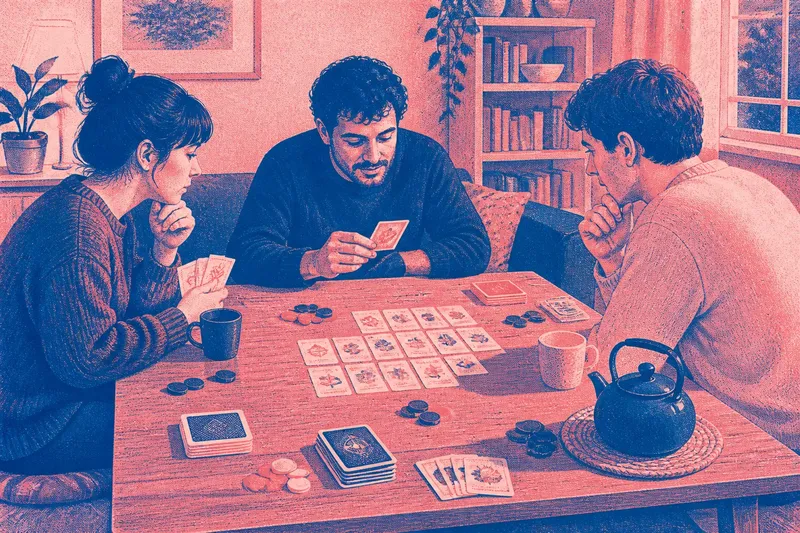
The rules that make a parlour game feel fair are being tested before the first move in a small sitting room. Three friends have opened a new card-and-token game, but its rule sheet leaves one question unanswered: can a player pass, then take a turn later? The cards are on the table, the kettle is cooling, and nobody wants to appoint a judge for the evening.
Imagine the three friends agree that a pass ends a player’s turn, and that play moves clockwise. They also decide that every card is played face up unless its text says otherwise. This is an invented situation, not a report of a real game. It gives us a useful way to see how turn-taking, shared information and the ending can make a game feel fair while leaving room for surprise.
What makes a turn easy to follow?
In the imagined game, each player begins with a small hand of cards and a few wooden tokens. On a turn, a player may play one card, exchange a token for a card, or pass. The order is fixed, and the available actions are stated in plain language. That matters because players can spend their attention deciding what to do, rather than negotiating what the rules mean.
A turn order should answer three practical questions: who acts next, what choices are available, and when control passes on. “Take turns clockwise” answers only the first. If players can interrupt, react or take extra turns, the rules need to say when those exceptions apply. Otherwise, a quick player may acquire an advantage simply by speaking first.
In this case, the group settles on a simple timing rule: a player completes one action, resolves its effects, then announces the next player. If a card allows an interruption, it must be played before the next player begins an action. That boundary gives everyone a clear moment to respond. It also prevents the familiar table-side argument about whether a reaction came just in time.
There is a small social benefit to explicit passing. A player who has no useful move can decline without being treated as if they have missed a hidden opportunity. The rule does not make everyone’s options equally attractive; it makes the point at which one person’s turn ends visible to all.
Which information should everyone share?
The friends now need to decide what can be seen. They put the draw pile face down, discard pile face up, and played cards in the centre. Each player keeps their hand hidden. The number of cards in every hand remains visible, using a simple count rather than asking someone to reveal their choices.
This arrangement creates a distinction between public information and private information. Public information lets players follow the state of play: which cards have been used, how many tokens remain, and whose turn it is. Private information gives each player room to plan. A fair game need not disclose everything. It should disclose the rules that govern hidden information, so nobody learns halfway through that one player had been allowed to inspect the draw pile.
Imagine one player claims that a card in the discard pile was never played. Because the pile is visible, the group can check without relying on memory. If the card had been hidden in a personal discard stack, the same disagreement might depend on whoever was most confident. Shared information works a little like a clear jar on a shelf: the contents need not all be available to everyone, but the jar’s position and purpose should not be a mystery.
Information also needs consistent handling. If a card is drawn and immediately revealed, the rules should apply that procedure to every player in the same situation. If players may choose whether to reveal a card, that choice should be explicit. Consistency is not the same as giving everyone identical cards; it means that comparable actions are governed by the same public rule.
How can choices stay uncertain without becoming obscure?
Once the turn order and visible areas are agreed, the game still needs decisions that matter. The friends’ invented rules give each card a clear effect, but a player may choose when to use it. A card that adds a token could be played now for a modest gain or held in case a later card makes the tokens more valuable. The outcome is uncertain because players make choices, not because the rules are concealed.
That distinction is important. Predictability comes from having no meaningful alternatives; confusion comes from being unable to tell what an action does. A well-described card can create an unpredictable result if its timing, target or cost is clear and players must judge one another’s intentions. A vague card can create a surprise too, but it is the sort that sends everyone back to the rule sheet.
In the sitting-room game, the group notices that one card says “take a token from a player” without specifying whether the player may be chosen. They amend the wording before continuing: the active player chooses one opponent who has a token, and that token moves to the active player. The choice remains tactical, while the legal target and effect are settled in advance.
Useful uncertainty can also come from hidden hands, a shuffled deck or a choice between several legal moves. Each source has a different feel. Hidden hands reward inference; a shuffled draw introduces chance; several legal actions reward judgement. A game can combine them, but the rule sheet should make clear which uncertainty is intentional and which details are fixed.
What should end the game?
After a few rounds, the friends ask whether the game ends when the draw pile is empty, when a player runs out of tokens, or when someone reaches a score. A useful end condition answers both when play stops and how the winner is decided. If those are separate rules, both should be stated.
For their invented game, they choose a visible target: the game ends at the close of a round when a player collects the final token from the centre. Everyone completes the same number of turns in that round, then the player with the most tokens wins. If two players tie, the rules say they share the win. The ending is not necessarily the only fair option, but it is observable and does not depend on a host deciding that the game has gone on long enough.
A round-based ending can help when turn order creates small advantages. If a player triggers the end condition, finishing the round gives the others a chance to act under the same structure. Other games may use a last turn, a final scoring phase or a fixed number of rounds. The right choice depends on what the game is trying to make players consider; the rule must make the stop point and final comparison legible.
There is also a practical question of stalemate. If no player can trigger the target, the game needs a fallback such as ending after a clearly defined event and comparing a stated score. A fallback should not introduce a fresh judgement call at the moment everyone is ready to pack away. In this case, the friends add that if the draw pile runs out, the current round finishes and the player with the most tokens wins.
Where do players look for answers?
The first round exposes a minor gap: does exchanging a token count as an action, or can a player exchange and then play a card? The friends add a sentence to their notes: choose one action on a turn, and resolve it fully before passing play. This is not elegant prose, but it answers the question at the table. A rules sheet is useful when players can find the rule they need without reconstructing the designer’s intention.
For a home-made game, keep related rules together. Put turn order and available actions in one section, card timing beside the card effects, and ending conditions near the scoring rule. Define recurring terms once, then use the same wording throughout. “Discard pile” should not become “used cards” in another paragraph if the two phrases might mean different things.
Say you are hosting a game night and a guest asks whether a face-up card can be taken by the next player before its effect resolves. You check the written timing rule, see that effects resolve before the turn passes, and answer without inventing a new exception. The expected observable result is simple: the group continues from the same shared understanding, even if the card changes who is likely to win.
What questions do players ask about fair game rules?
Does a fair game need equal turns?
Not always. Some games deliberately give players different roles or actions, but the rules should explain those differences and apply them consistently. Equal opportunities to act are one route to fairness, not its only form.
Should every card be visible?
No. Hidden cards can support bluffing and inference, provided the rules clearly state what is hidden and when information is revealed. Public details such as turn order and scoring should remain easy to check.
Can chance still feel fair?
Yes, if the source and handling of chance are shared and understood. A shuffled deck can produce uneven luck, but players should not face different procedures for drawing or resolving the same kind of card.
What if the rules do not cover a dispute?
Pause, agree on a temporary interpretation, and record the gap for later revision rather than changing the rule to favour the player who raised it. If the game is published, follow its supplied errata or clarification where available.
What does the imagined evening show?
By the end of the invented evening, the friends have not removed every surprise. They have removed the avoidable kind: uncertainty about whose turn it is, what a card does, what information can be checked, and when play stops. Players can still misread a rival, draw an awkward card or choose poorly. Those are parts of playing, not failures of the rules.
The rules that make a parlour game feel fair do not promise equal fortunes or predictable outcomes. They give players a common account of what actions mean and how the game will end. When a group revises a rule, the most useful test is whether everyone can now point to the same procedure before the next move begins. The kettle can be reheated; the argument need not be.